

When you ask an AI a question, there's more happening behind the scenes than you might think. Understanding how this works helps explain why AI systems can sometimes seem brilliantly informed, and other times completely miss the mark.
By Matt Conway
Two types of AI instructions
Every conversation involves different layers of instructions, most importantly system instructions and user questions.
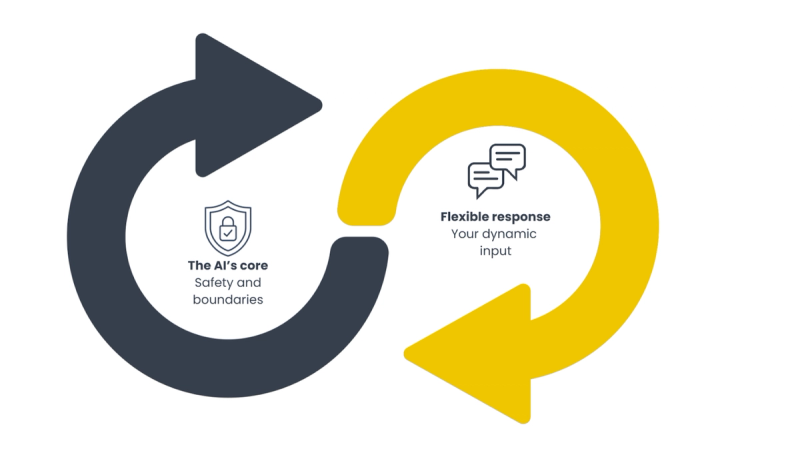
System instructions – These are the ground rules set by the developer. They define the AI's personality, what it can and can't discuss, and how it should behave. Think of this as the AI's job description.
Your question – This is what you actually ask. It changes with every interaction, whilst the system instructions stay the same.
This separation is crucial because it means we can set consistent safety boundaries and maintain a reliable personality, whilst still allowing the AI to respond flexibly to whatever you ask.
The problem: AI doesn't know everything
Standard AI models only know what they learnt during training. They can't access your company's internal documents, they don't know about events after their training ended, and they certainly can't read that policy document you just published last week.
This is where Retrieval-Augmented Generation (RAG) comes in.
The solution: give AI access to your knowledge
RAG is a technique that connects an AI model to your actual documents and data. Instead of relying solely on what it learnt during training, the AI can now search through your specific knowledge base and use that information to answer questions.
Here's how it works:
1. Prepare your knowledge
We break your documents into manageable chunks and convert them into a searchable format
2. Search when needed
When you ask a question, the system finds the most relevant pieces of information
3. Combine and respond
Those relevant pieces are fed to the AI alongside your question, so it can give you an accurate, informed answer
Breaking down documents: the chunking strategy
We can't simply throw entire documents at an AI, that would overwhelm it. Instead, we break documents into smaller, meaningful pieces. There are several approaches:
- Fixed sections
Divide documents into chunks of a specific size, with some overlap to maintain context
- Natural breaks
Split at logical points like chapter headings or paragraph boundaries
- Topic-based
Group related content together based on meaning
The goal is to create chunks that are small enough to process efficiently but large enough to remain meaningful.
Finding the right information: search technology
Once documents are chunked, we convert each piece into a mathematical representation called a vector. This allows us to search not just for matching keywords, but for meaning.
When you ask a question, your query is also converted into a vector, and the system finds the chunks that are most semantically similar. It's like having a librarian who understands not just the words you're using, but what you actually mean.
Bringing it all together
When you interact with a RAG-powered AI system:
1. The system receives your question
2. It searches through the indexed knowledge base to find relevant information
3. It combines the system instructions, the retrieved information, and your question
4. The AI generates a response based on all of this context
The result is an AI that answers accurately based on your specific documents, follows the safety and style guidelines you've set, and maintains a consistent personality throughout the conversation.
Why this matters for your organisation
RAG transforms AI from a general-purpose tool into a specialist that knows your business. It can:
- Answer questions based on your actual policies and procedures
- Stay up to date as you add new documents
- Provide consistent information across your organisation
- Reduce the risk of AI "hallucinating" or making up answers
Key considerations
Whilst RAG is powerful, there are important factors to keep in mind:
- Capacity limits
AI models can only handle so much information at once, so we need to be selective about what we retrieve
- Quality control
The system should verify that retrieved information is actually relevant before using it
- Privacy
Sensitive documents must be stored securely, using systems that provide strong access controls and clear guarantees about data usage.
- Accuracy
Always cross-reference AI responses against source documents for critical decisions
- Interpretation
Even with correct documents, models can misinterpret or oversimplify content.
- Model behaviour can still introduce errors even with correct retrieval (misinterpretation, over-confidence).
The bottom line
By separating how we instruct AI systems from what we ask them, and by giving them access to your specific knowledge base, we create AI tools that are both reliable and informed. This isn't just about making AI smarter, it's about making it useful for your actual business needs.
At Answer Digital, we specialise in implementing these techniques to help organisations harness AI effectively, ensuring it's grounded in your reality rather than just making educated guesses.